Table of Contents
- Why Networking With Enthusiasts Beats Generic Mixers
- Start With Car Enthusiast Clubs and Local Meetups
- How to Start a Conversation at a Car Show
- Social Media Groups for Car Enthusiasts: Where to Find Your People
- Send a Follow-Up Message After Meeting Someone
- The Best Ways to Network With Enthusiasts Online and In Person
- Keep Connections Alive: From One Chat to a Real Friendship
- Conclusion: Pick One Channel and Show Up Again
- Frequently Asked Questions
Last Updated: October 16, 2026
Why Networking With Enthusiasts Beats Generic Mixers
The best ways to network with enthusiasts start with one advantage generic mixers can never match: you already share something real.
At Rocket City Corvettes, we see this every month at our cruises and car shows across the Space Coast.
This guide covers seven proven paths, from local clubs to online groups, plus the follow-up habits that turn a chat into a friendship.
Shared-interest networking works because the topic is built in. You are not searching for common ground; you are standing on it.
Start With Car Enthusiast Clubs and Local Meetups
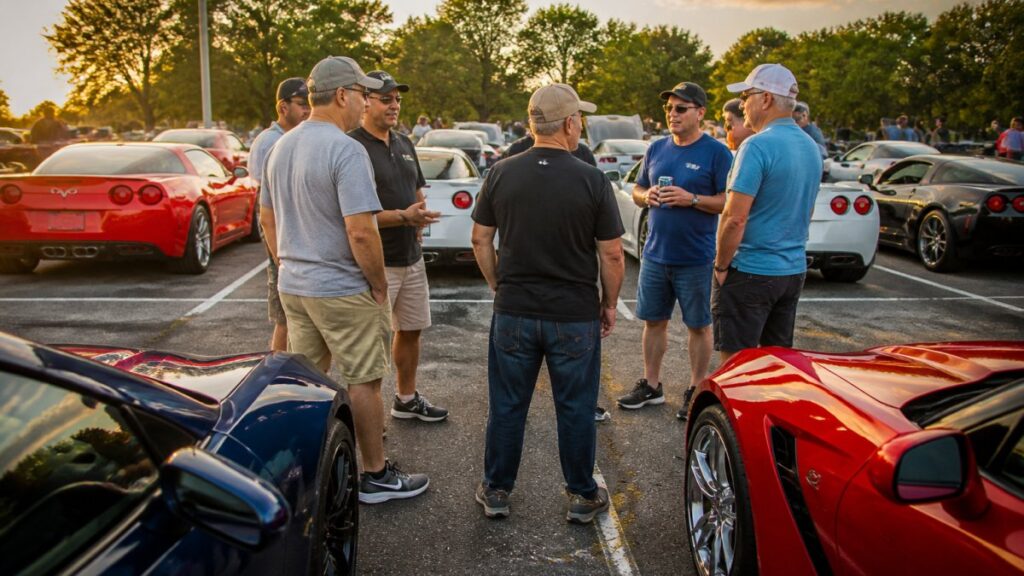
Car enthusiast clubs and local meetups are the fastest route to real connections. A club gives you recurring events, familiar faces, and a built-in reason to show up again. That repetition is what turns strangers into friends.
Look for groups that meet at least monthly; a club that gathers twice a year will not build momentum. Ask three questions:
- How often do you hold events, and where?
- Is the crowd welcoming to new owners, or mostly longtime collectors?
- Do members stay after the official event to talk?
A common mistake is joining, attending once, and disappearing. The members who build the strongest friendships show up three months in a row.
How to Start a Conversation at a Car Show
Starting a conversation at a car show is easier than most people think, because the cars give you a script. Compliment something specific, ask an open-ended question, and let the owner talk.
Five Openers That Work in the First Ten Seconds
- “That color is incredible. Is it the original paint?”
- “How long have you owned it? I bet there’s a story there.”
- “What’s the best drive you’ve taken it on?”
- “I’m new to this. What should I know about this generation?”
- “Mind if I ask what you’ve done under the hood?”
Each opener invites a real answer rather than a yes or no. Then practice active listening: ask follow-ups, remember a detail, and reference it later.
Ask about the story behind the car, not just the specs. Specs get swapped between strangers; stories create a reason to remember you.
Social Media Groups for Car Enthusiasts: Where to Find Your People
Social media groups for car enthusiasts are the best way to network between events. Search for groups tied to your model, region, or interests, then watch how members interact before posting.
A healthy group looks different from a transactional one. Watch for these signals:
| Signal | Healthy Group | Low-Quality Group |
|---|---|---|
| New member posts | Warm welcomes, real replies | Ignored or mocked |
| Content mix | Photos, questions, event invites | Only for-sale ads |
| Moderation | Clear rules, active admins | Spam left up for days |
| Meetups | Members actually attend | Talk only, no events |
When you find a good group, engage before you promote anything: answer a question, congratulate a new purchase, share a photo from your last drive.
Send a Follow-Up Message After Meeting Someone
A follow-up message after meeting someone is the step most people skip, and it costs them the connection. Send it within a day or two, while the conversation is fresh.
Keep it short and specific:
“Hey [name], great talking with you at the show on Saturday. That story about your first Corvette stuck with me. Hope to see you at the next cruise.”
That is it. No pitch, no ask. The goal is simply to reopen the door. If you connected on social media, a direct message works fine. If you only exchanged names, ask a mutual contact to make an introduction.
Waiting a week or more to follow up makes the message feel calculated. Send it within 48 hours or accept that the connection likely fades.
The Best Ways to Network With Enthusiasts Online and In Person
The best ways to network with enthusiasts combine online and in-person channels, because each covers the other’s weakness. Online groups keep you connected between events; in-person events turn usernames into real friends. They are one pipeline, and the handoff is where the connection is made or lost.
The Online-to-In-Person Pipeline
Think of every channel as a stage in a single funnel, not a standalone tactic.
| Stage | Channel | Your Job | Exit Signal |
|---|---|---|---|
| Discover | Forums, subreddits, model-specific groups | Lurk, learn the norms, note who posts often | You recognize three or four regular names |
| Engage | Comment threads, group chats, live streams | Add value: answer a question, ID a part, share a photo | Someone replies to you by name |
| Bridge | Direct message or group event thread | Move from public thread to a one-on-one or a planned meetup | You have a date, time, and place |
| Meet | Club meeting, cruise, car show, convention | Show up, find the person, spend real time | You have a shared plan for next time |
| Sustain | Recurring events, monthly check-ins | Repeat, introduce, invite | You are the one organizing |
Most people stall at Engage, commenting for months without bridging. The bridge is one sentence: “A few of us are meeting at the Saturday cruise, want me to save you a spot?”
Channel-by-Channel Playbook
- Clubs and meetups: Your anchor. Attend monthly and volunteer for one task, parking, check-in, photos. Volunteers meet everyone.
- Social media groups: Comment on three posts a week, do not just lurk. Post your own photo once a month so your name has a face attached.
- Events and conferences: Aim for three real conversations, not thirty handshakes. Write the three names down before you leave.
Safety, Privacy, and Boundaries in Enthusiast Communities
Safety and privacy matter in enthusiast communities, especially online, because the same passion that makes people easy to talk to makes them easy to overshare with.
Protect your information. Keep your home address, daily schedule, and license plate out of public posts, enthusiast forums are searchable, and driveway photos reveal more than you intend.
Set your own boundaries. You do not owe anyone your phone number, your real name, or a ride.
A DM that asks for your address, your schedule, or money within the first few messages is a red flag, not a fast friendship. Report it and move on.
A Simple Weekly Rhythm
You do not need every channel. Pick two and run this loop:
- Monday: One comment in your main online group.
- Midweek: One DM to someone you have not talked to in a month.
- Weekend: One in-person event, even if it is just an hour.
That rhythm produces roughly four touchpoints a week and about a dozen real conversations a month. Over a season, that is a network.
Keep Connections Alive: From One Chat to a Real Friendship
Keeping connections alive takes deliberate effort, and it is where most networks quietly die. A single great conversation is not a relationship, repetition is. The fix is to track a small number of relationships on purpose.
Score the Relationship, Not the Contact Count
Most people measure their network by how many names they have. That number is useless. Measure quality instead, using four signals:
| Signal | Weak | Warming | Strong |
|---|---|---|---|
| Reply speed | Days or never | Same day | Hours, and they start threads too |
| Depth | Car specs only | Car plus life details | They ask about your project unprompted |
| Reciprocity | You always initiate | Mixed | They invite you first |
| Off-topic | None | Occasional | They text about non-car things |
A contact who hits two or more “strong” signals is a real friend in the making. One stuck at “weak” after three months is an acquaintance, spend your energy where the signals are warming.
The Three-Tier Follow-Up System
Sort the people you meet into three tiers and treat each one differently. The whole system takes about ten minutes a week.
- Tier 1, Inner circle (3 to 7 people): The ones you would call for a Saturday drive. Reach out every two to three weeks with something specific: a part you saw, a show coming up, a question about their build. Invite them by name to the next event.
- Tier 2, Active contacts (10 to 20 people): People you have had a real conversation with. Reach out monthly. A photo from a show they would have liked counts, as does a one-line “saw this and thought of your project.”
- Tier 3, The wider room (everyone else): No individual follow-up needed. Stay visible at the same recurring events and post occasionally in the group. Familiarity does the work.
Be the Connector
The highest-leverage habit in an enthusiast community is introducing two people who should know each other. “You two both run the same intake setup, you should compare notes.” That sentence helps both people, makes you the hub, and gives you a reason to follow up with both later.
Remember Details Without Being Creepy
You are not expected to memorize everything, just one thing. After a conversation, note a single detail: their car, their project, the drive they are planning. A phone note is enough. Then reference it next time: “How did the transmission swap go?”
Show Up on a Schedule, Not on a Mood
Consistency beats intensity. Pick one recurring event and make it a standing appointment. The members who build the strongest friendships are not the ones who attend everything for a month and vanish; they show up to the same monthly cruise for a year. Faces become familiar, familiar becomes comfortable, and comfortable becomes friendship.
Track your Tier 1 list in your phone’s notes app with a one-line reminder for each person. Review it every Sunday. Ten minutes of review beats an hour of scrolling.
When to Let a Connection Fade
Not every contact becomes a friend, and that is not a failure. If you have reached out twice with no reply, stop. Leave the door open, keep showing up, keep commenting, and let them come to you.
New members and anyone who feels nervous walking into a room of strangers. Start with one recurring event and one online group, then build from there.
Conclusion: Pick One Channel and Show Up Again
The hardest part of networking is not the first conversation; it is the second visit. Confidence, authenticity, and approachability grow from repetition, not from a perfect opener. Choose one channel, whether a local club, an online group, or a monthly meetup, and commit to showing up again.
That is exactly what we built Rocket City Corvettes for. As the fastest-growing Corvette club in Brevard County, we welcome owners from across the Space Coast with organized cruises, car shows, club-exclusive merchandise and apparel, and chances to be featured on our social media and recognized at shows.
Frequently Asked Questions
How can I start a conversation with another Corvette enthusiast?
Lead with something specific you can see. Compliment the car, not the person: “That C8 color is sharp, is it a 2026?” Then ask an open-ended question about how they got into Corvettes. Owners love telling that story. Keep your first exchange to two or three minutes, listen more than you talk, and ask a follow-up question before you walk away. If the chat goes well, offer your name and ask if they attend local club events.
What should I do after meeting someone at a car show?
Send a follow-up message within 48 hours while the conversation is still fresh. Mention one specific detail from your chat, like the restoration project they described or the show you both plan to attend. Keep it short: two or three sentences and one clear next step, such as meeting at an upcoming cruise. This single habit separates people who collect contacts from people who build real friendships in the hobby.
How do I meet people who share my car interests?
Go where the interest already lives. Local car enthusiast clubs, weekend cruises, charity car shows, and model-specific social media groups all put you in a room (or a feed) full of people who already care about the same thing. Pick one club and one online group, show up consistently for a few months, and volunteer for a small task. Familiar faces become friends faster than any introduction strategy.
I’m new to Corvette ownership and don’t know anyone. Will I fit in?
Most clubs welcome new owners, and many members started exactly where you are. You do not need a rare model or decades of knowledge to belong. Bring curiosity, ask about other members’ cars, and let people teach you. Clubs that run new-member welcomes, casual cruises, and social hours make it easy to ease in. Give it two or three events before deciding whether it feels right.
How can I build lasting connections in a car club?
Consistency matters more than charm. Attend regularly, remember names and details, and follow up after events. Volunteer for a committee, help at a show, or join a cruise planning group. People bond through shared work and repeated contact, not one perfect conversation. After a few months of showing up, you will likely have a handful of genuine friendships rather than dozens of surface-level contacts.
What are some creative ideas for a networking session with enthusiasts?
Try a themed cruise with a photo stop, a tech day where members help each other with small projects, a charity wash-and-shine, or a coffee-and-cars morning at a local lot. Pair the activity with a simple icebreaker, like asking each person to share the story behind their car. Structured activities give shy members something to do while conversation happens naturally around the task.